
100 Years of Gassman
Vittorio, a bandit in Abruzzo
01
SEPTEMBER 2022
Vittorio Gassman
I Briganti Italiani
Mario Camerini
For lovers of Italian cinema, 2022 is a year packed with significant anniversaries.
This year marks the 100th anniversary of the birth of Pier Paolo Pasolini (Bologna, March 5, 1922), while on September 1, 1922—exactly 100 years ago—the legendary actor Vittorio Gassman was born in Genoa; a once-in-a-lifetime event, therefore, which in turn has sparked a whirlwind of quality cinema being screened across the country, along with specially produced documentaries, previously unseen interviews, and numerous television specials. A real treat for every fan.
This is how films like I soliti ignoti, Accattone, Il sorpasso, Salò, Il Tigre, and L’Armata Brancaleone once again become simply part of our everyday lives, and the passage of time—the simple human need to celebrate anniversaries—becomes an opportunity for some to exercise their memory, and for others, something far more important: the pure pleasure of a new discovery.
“The future is already here, and we haven’t even noticed it”
Vittorio Gassman, We Once Loved Each Other So Much
Alongside the exhibitions dedicated to the star of Italian comedy at the Palazzo Ducale in Genoa and the Auditorium Parco della Musica in Rome, we at CinemAbruzzo also wish to pay tribute to the actor by highlighting Mario Camerini’s film I Briganti Italiani (1961), perhaps one of Gassman’s lesser-known films, but a very important one from a historical perspective. The film aims to recount one of the most painful periods in Italian history, which affected the entire South, including parts of the Abruzzo Apennines: post-unification banditry.
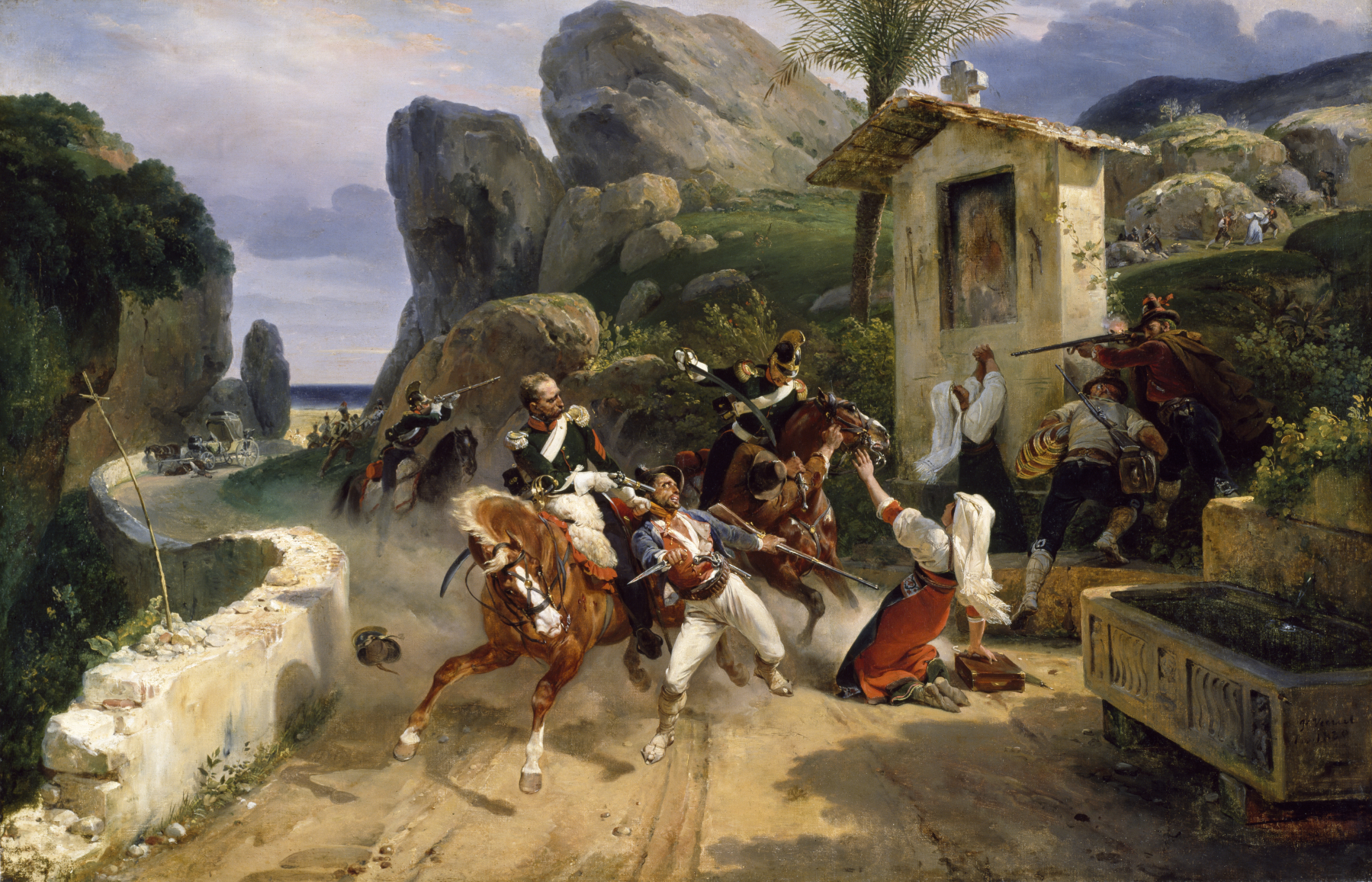
Bandits Surprised by Papal Troops (1831) by Horace Vernet
1861. In the aftermath of the Piedmontese army’s victory over the Bourbon forces and the subsequent unification of Italy, Vincenzino, known as O’ Caporale (Vittorio Gassman), is still in command of a unit of stragglers from the Kingdom of the Two Sicilies. Defeated and stripped of their possessions, now certain that the promises of wealth made by Francis II of Bourbon have been broken, they reluctantly decide to join the band of brigands led by Sante Carbone (Ernest Borgnine).
Through raids, plundering, and killings, Sante Carbone’s gang continues to sow panic in the region, even putting the Piedmontese occupation army in the south in check. Attracted by the allure exerted by the legendary figure of the brigand on the masses of peasants disillusioned by the war’s outcome and on the former soldiers of the Kingdom of the Two Sicilies now in disarray, some alleged emissaries of the exiled King Francis II hire Sante Carbone with the task of forming an army of brigands and volunteers and, under the Bourbon banner, driving out the Piedmontese invaders and restoring the Kingdom of the Two Sicilies.
After a series of initial lightning victories in several towns garrisoned by the Savoy army, when well-equipped reinforcements from the north arrived, the brigands—ferociously repelled into the mountains—decided to break ranks and abandon Sante Carbone to his inevitable fate.
The film, which takes on the daunting task of depicting a complex and fragmented phenomenon such as post-unification Italian brigandage, was primarily shot in Cerreto Sannita in the province of Benevento and in Cerro al Volturno in Molise, in the province of Isernia—just 20 km from the Abruzzo border—as well as in the hamlets of Foci and Valloni and in the town of Manziana in the province of Lazio. Some significant scenes from the film were shot in Abruzzo, between the towns of Pescocostanzo and Alfedena. In particular, the glorious battle for the conquest of Sante Carbone’s hometown was filmed among the houses of Alfedena; it has been compared, for its meticulousness, abundance of set pieces and extras on horseback, to John Ford’s furious shootouts on the prairies of the Wild West, as stated on the back of a restored still from the film, held in the archives of the Cineteca di Milano.
The film attempts to recount what is now, after more than 150 years of analysis, considered perhaps the most repressive and bloody decade of the Kingdom of Italy; it is interesting to note that the locations where the drama is set are the very same ones that witnessed the uprisings of this group of men—who differed in their ideals and objectives but were uniformly labeled “brigands.”
In fact, Abruzzo too, during the decade from 1860 to 1870, was the site of a harsh crackdown on brigandage, especially in the Apennine region of Maiella. Even today, walking along the trails of Monte Focalone, one can admire the so-called “Tavola dei Briganti,” a series of limestone rocks on which traces of shepherds and brigands who carved crosses, names, dates, symbols, and the following inscription are still visible:
“Read my memoir, dear readers. In 1820, Victor Emmanuel, King of Italy, was born. Before 1860, it was a land of flowers; now it is a land of misery.”
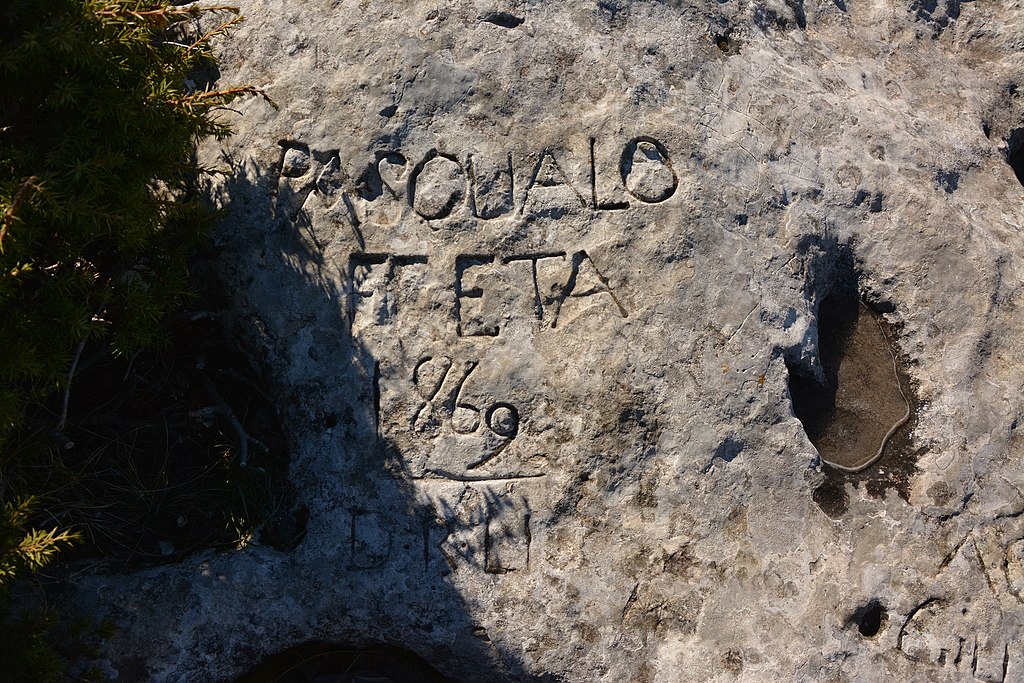
Photo of the “Tavola dei Briganti”
If you’re curious to learn more about the connection between Abruzzo and Vittorio Gassman, we recommend checking out this previous article from CinemAbruzzo:
The Desert of The Tartars – Abruzzo in Valerio Zurlini’s film.

Samuele Coccione
An exile by necessity, but mostly out of masochism.
I love movies, books, and boredom.
I’ve been writing about Abruzzo cinema ever since it was “cool”
to be stuck at home.
I live in Milan, but I dream of working remotely with my feet soaking in the Tirino River.