
Christ among the Bricklayers
The Abruzzo legacy in the American Dream
12
OCTOBER 2023
Pietro Di Donato
Columbus Day
On October 12, the United States celebrates Columbus Day, a national holiday formally observed to commemorate Christopher Columbus’s voyage to the Americas. The first celebrations of this date date back to the late 19th century and were organized primarily by Italian-American communities to highlight their pride in their heritage and their contribution to American history. Among these immigrant groups, there were countless people from Abruzzo who helped etch October 12 into the history of the United States of America, including Vincent Massari, a native of Luco Dei Marsi who arrived in America in 1915, just a few days before the Avezzano earthquake and the outbreak of World War I profoundly transformed all of Italy and, in particular, the Marsica region.
(Vincent’s story was rediscovered and vividly recounted by Alessio De Stefano in his wonderful book Vincent Massari. Cronache di un abruzzese d’America, published by Radici Edizioni).
These celebrations, which initially took place in a spontaneous and unstructured manner, did not become the national holiday we know today until 1937, when President Franklin Delano Roosevelt officially proclaimed October 12 as Columbus Day.

Portrait of Christopher Columbus painted by Ridolfo Bigordi, known as Ghirlandaio. Over time, this image has become established as the navigator’s “official” likeness © Galata Museo del Mare, Genoa.
In recent years, Columbus Day has become a subject of controversy due to historical issues surrounding Christopher Columbus. Some critics point out that his arrival in the Americas led to clashes and conflicts between Europeans and Indigenous peoples, with tragic consequences for the latter. Setting aside for a moment the more historiographical connotations tied to the origins of the United States, Columbus Day offers an opportunity to reflect on recent American history, immigration, and cultural identity; a critical moment of self-reflection that provides an opportunity to remember the many challenges faced by Italian immigrants throughout American history. In fact, prior to its establishment, Italians were notoriously subject to prejudice and discrimination, as recounted in numerous novels of the era.
One of the greatest novels on this theme is Christ in Concrete (Cristo fra i muratori), which draws on Abruzzo and the culture and traditions of the villagers of the Vasto area in its narrative. Pietro Di Donato, author of the autobiographical novel published in 1939, tells the story of his father Geremio and his mother Annunziata, both immigrants from Abruzzo, and of his difficult childhood as an Italian-American in the early decades of the 20th century.

Audiobook recorded on vinyl of the novel Christ in Concrete, written by Pietro Di Donato and narrated by the renowned actor Eli Wallach (The Good, the Bad and the Ugly) © Da Vinci Records
Pietro Di Donato was born on April 3, 1911, in West Hoboken, New Jersey, to Italian immigrant parents from Abruzzo, specifically from Vasto and Taranta Peligna. His parents were part of the community of immigrants from Vasto who worked as bricklayers. The difficulties and challenges faced by his family and the broader Italian-American community deeply influenced his literary interests, but the event that turned the young Di Donato’s life upside down was his father’s death, which occurred at work in 1923 and from which Christ Among the Bricklayers draws abundant inspiration.
The novel tells the story of Geremio, an Italian immigrant bricklayer who loses his life in a tragic accident at a construction site in New York City. The novel then explores the grueling working conditions and exploitation endured by the workers who built American skyscrapers and high-rise buildings.
“Will it ever be possible to breathe the air of God without it being polluted by the shadow of unemployment? And by having to make money for the boss? The fear of Work and the Boss? To rebel means losing everything—even the very little one possesses. To obey means suffocating.”
Geremio, from Christ Among the Bricklayers (1939)
Di Donato also recounts, in great detail, the customs, rituals, bigotry, and hardships of the Italian-American community. Memories of Abruzzo, their homeland left inexorably behind, cast a bitter shadow over the lives of these hardworking laborers chasing the American dream.
In the book, following the first section dedicated to his father Geremio, the author begins a lengthy autobiographical section focused on “Work,” which he first encountered at the age of twelve. Like his father, he starts as a bricklayer among his fellow countrymen and reveals the behind-the-scenes reality of the glossy years of the American boom, before the 1929 crisis. In addition to a detailed description of the working-class world—to which he will always feel connected even after achieving fame and success—Pietro Di Donato describes in the book the tenements teeming with immigrants (Jews, Scots, Irish, Italians) and the hard years that followed the 1929 crisis, painting an interesting and evocative picture of those years that marked the peak of immigration from Italy and Abruzzo.

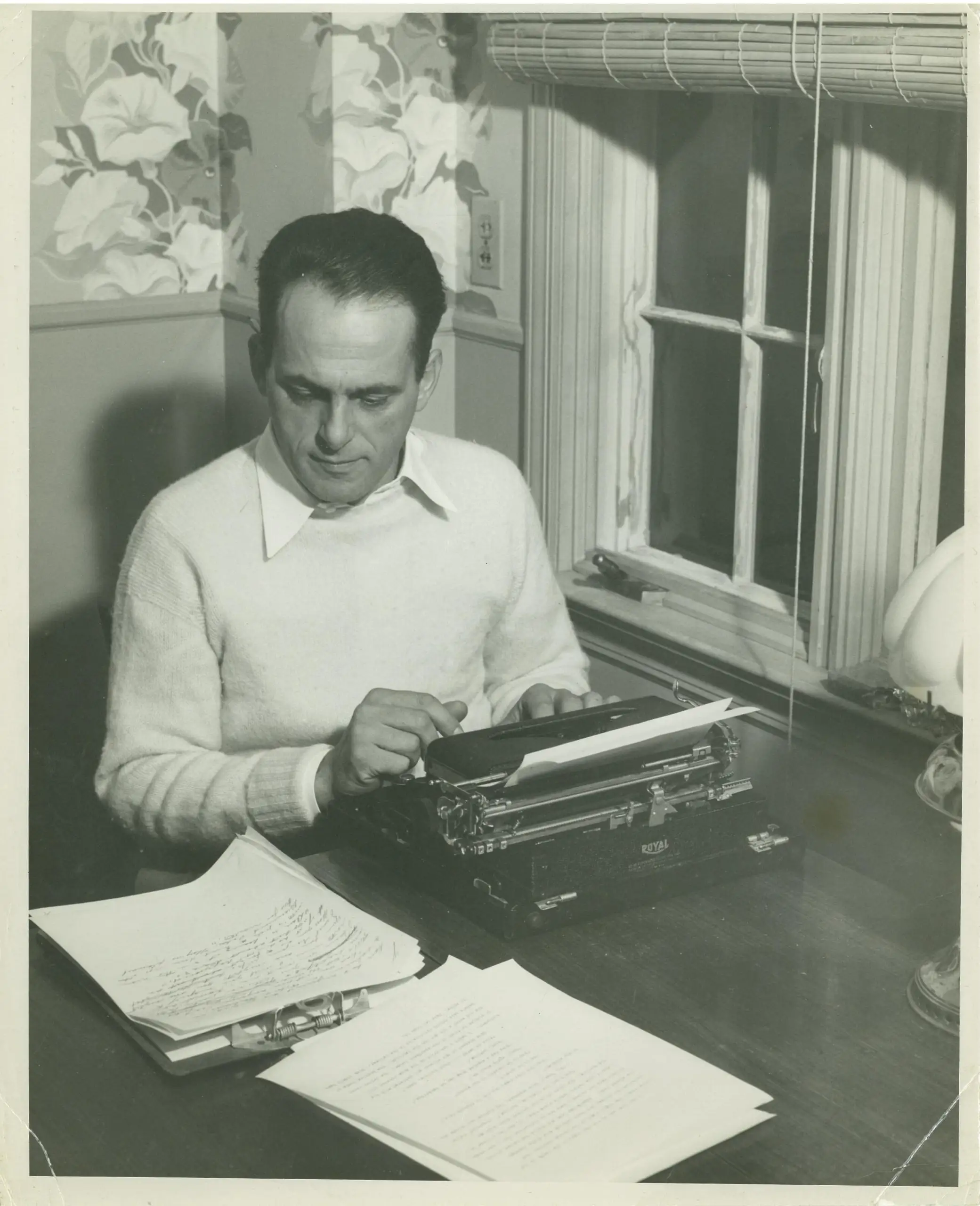
The first photo shows Geremio, known as Jerry Di Donato, the father of Pietro Di Donato, who died on Good Friday evening in 1923. The second photo shows Pietro Di Donato typing in 1951. © Richard Di Donato (https://pietrodidonato.com/)
When Christ Among the Bricklayers was first published, it received widespread praise for its raw and authentic portrayal of immigrant life, although some criticized the novel’s challenging language and style (which features numerous Italianisms and the use of dialect). Nevertheless, the novel immediately attracted considerable attention and acclaim, establishing itself as a classic of working-class literature, and in particular of Italian-American literature. Unfortunately, John Steinbeck’s The Grapes of Wrath, which dealt with very similar themes, was also published that same year. This, along with Pietro Di Donato’s decision to become a conscientious objector in 1941 when the United States entered World War II, contributed to the rapid marginalization of the author’s stance and themes and to the obscuring of his talent.
Despite these upheavals, the book was optioned for a film adaptation after the war by producer Rod E. Geiger, who had been particularly close to Italian Neorealism during the war years, having produced several of Rossellini’s films in Italy, such as Paisà and Roma, Città Aperta. The film’s production was fraught with difficulties, as the writer’s ties to the Communist Party were frowned upon during the McCarthy era. Subsequently, the film’s director, Edward Dmytryk, was blacklisted in Hollywood, and the entire production had to relocate from the United States to England.
The film was not a big box-office hit because its distribution was banned in the United States, but it received positive reviews from European critics, and the lead actors, Sam Wanamaker and Lea Padovani, won awards at the 1950 Venice Film Festival. Upon Dmytryk’s return to the United States, he was arrested and imprisoned for seventeen days.

Pietro Di Donato discusses the script with the film’s lead actor, Sam Wanamaker © Richard Di Donato
After 1950, Di Donato’s writing career resumed, and over the course of his life he produced seven more novels that would never match the success of his first autobiographical novel. In 2006, a documentary directed by Stefano Falco titled Pietro di Donato, the Writer-Bricklayer was released, detailing every stage of his career as an author and his return to Italy, particularly to the city of Vasto, where he is seen walking the same streets his father Geremio walked before emigrating along with hundreds of fellow villagers.
When I asked Richard, Pietro Di Donato’s second son, what his father thought of his Abruzzese roots, he told me this:
Because Paul Dadonna knew who he was: a self-taught authority on his own peasant lineage, which had migrated from the Adriatic coast up into the foothills, settling in a small town called Taranta Peligna—and then there was that intriguing story the mayor of Taranta had told him during his first trip to Italy. It told of the famous Italian poet and playwright, a count, an aesthete, an aviator, a libertine, a moral degenerate who promoted a libertine lifestyle in his literary works. He was also the man who had led his own army to conquer and occupy an entire city in the Kingdom of Hungary after the War to End All Wars—the man at the origin of fascism […]. This historical legacy particularly appealed to Paul. He liked the idea that both writing and seduction were in his blood. His dark mix of Hellenic, Italic, Persian, and Byzantine blood had circulated along the trade routes of war, flowing into every port of the ancient world.
Paul Dadonna, the alter ego of Pietro Di Donato. An excerpt from a text by Richard Di Donato

“The last brick of his life,” reads the caption on the website dedicated to the writer © Richard Di Donato
Per conoscere meglio la vita e le opere di questo abruzzese della letteratura mondiale vi invito a consultare il sito a lui dedicato, curato con amore e dovizia dal figlio Richard a cui va un grazie personale per averci concesso libero utilizzo del suo archivio personale.
To learn more about the life and works of this Abruzzese figure in world literature, I invite you to visit the website dedicated to him, lovingly and meticulously curated by his son Richard, to whom I extend my personal thanks for granting us free access to his personal archive.

Samuele Coccione
An exile by necessity, but mostly out of masochism.
I love movies, books, and boredom.
I’ve been writing about Abruzzo cinema ever since it was “cool”
to be stuck at home.
I live in Milan, but I dream of working remotely with my feet soaking in the Tirino River.