
Time to Kill
Ennio Flaiano’s Great Novel
20
NOVEMBER 2022
Ennio Flaiano
Time to Kill
50th anniversary
Fifty years after Ennio Flaiano’s death in Rome on November 20, 1972, we wish to join in the collective remembrance of one of Abruzzo’s most famous authors worldwide. Born in Pescara and adopted by Rome, Flaiano was born on March 5, 1910, in a house on Corso Gabriele Manthonè in Pescara. The youngest of seven children, he spent his childhood moving frequently with his entire family between Abruzzo, Lazio, and the Marche, before eventually moving to Rome in 1922.
Despite moving away at a very young age, Flaiano maintained a deep attachment to his native land throughout his life, as is evident from these excerpts from a letter he wrote to his friend Pasquale Scarpitti.
Now that you mention it, I too wonder what I’ve retained of my Abruzzese heritage, and I must say, alas, everything; that is, the pride of being Abruzzese, which wells up in my throat when I least expect it […] and this tells you that I wasn’t born in Pescara by chance: my father was born there too, and my mother came from Cappelle sul Tavo. My paternal and maternal grandparents were also from the Teramo area; my mother was proud of her mother’s village, Montepagano, which I’ve seen only once in passing, from the car, as we do, we poor travelers of today.
Pasquale Scarpitti, Disilusionment, Sarus, Teramo, 1972
A screenwriter, writer, journalist, humorist, lyricist, film critic, and playwright, Flaiano was an exceptionally complex and multifaceted author, whose name is today unjustly little known or associated solely with that of Federico Fellini, having collaborated for many years on the screenplays for the Romagna-born director’s films.
The following films were adapted from the stories and screenplays of the Pescara-born author: I Vitelloni (1953), La Dolce Vita (1960), and 8½ (1963)—perhaps the three great masterpieces of Maestro Fellini. After 1965, their collaborative relationship came to an abrupt end due to numerous disagreements between the two. In Fellini’s subsequent films, this drastic shift in tone would be very evident, and this may have been one of the reasons for the decline of his career in his final years of activity.
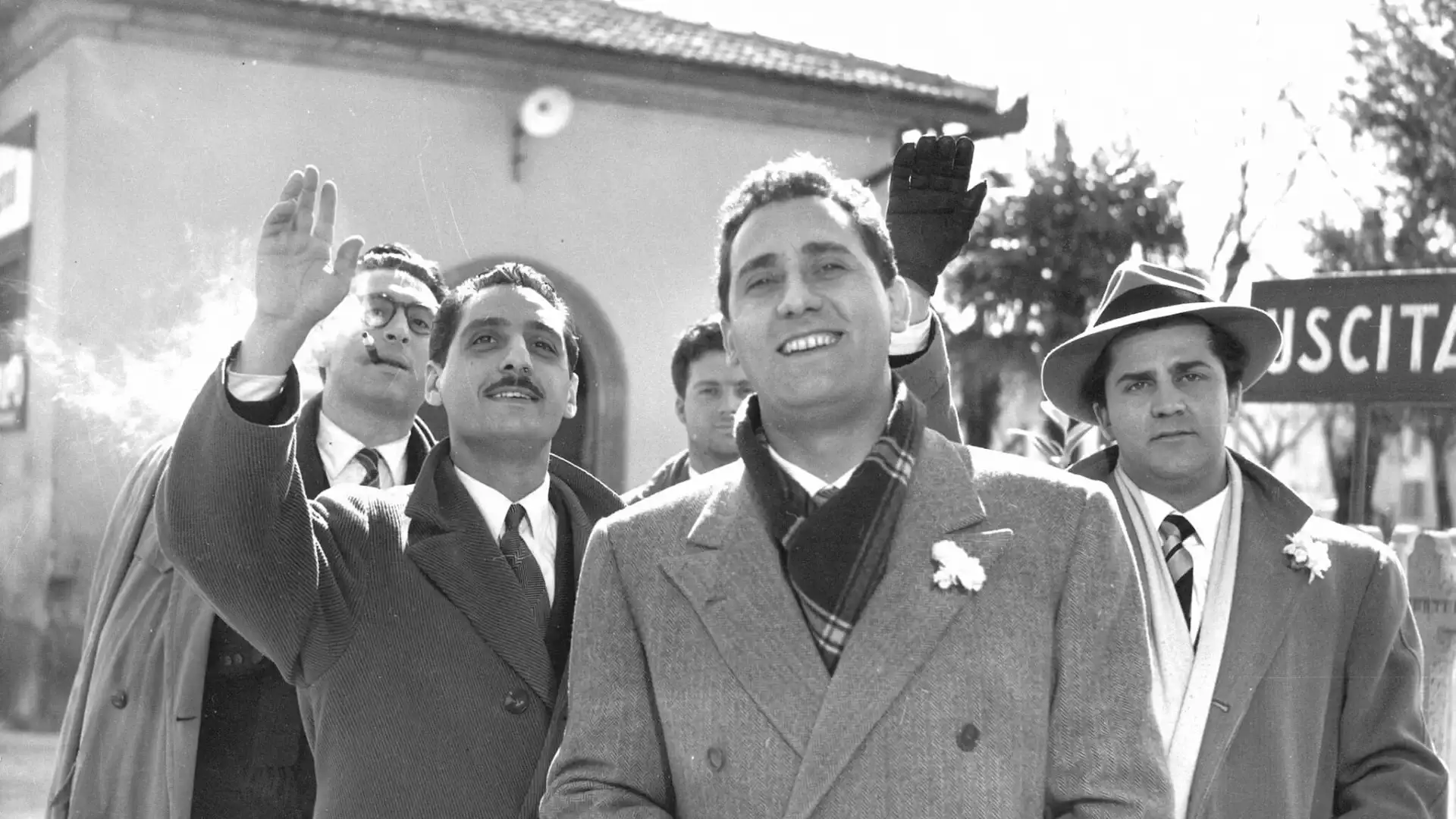
A still from Federico Fellini’s I Vitelloni (1953)
Given the indisputable place that Flaiano occupies, both then and now, in the pantheon of Italian cinema, what many people are unaware of regarding Ennio Flaiano’s life and artistic career is his stint as a novelist, and it is precisely this that we wish to discuss in this tribute to the author.
Flaiano wrote a single, great novel commissioned by Leo Longanesi in 1947: Tempo di uccidere (Time to Kill). The book, harshly criticized by the critics of the time, won the first Strega Prize, established that very year by the writer Maria Bellonci and Guido Alberti, the wealthy owner of the company that produces the Strega liqueur, which gives the prize its name.
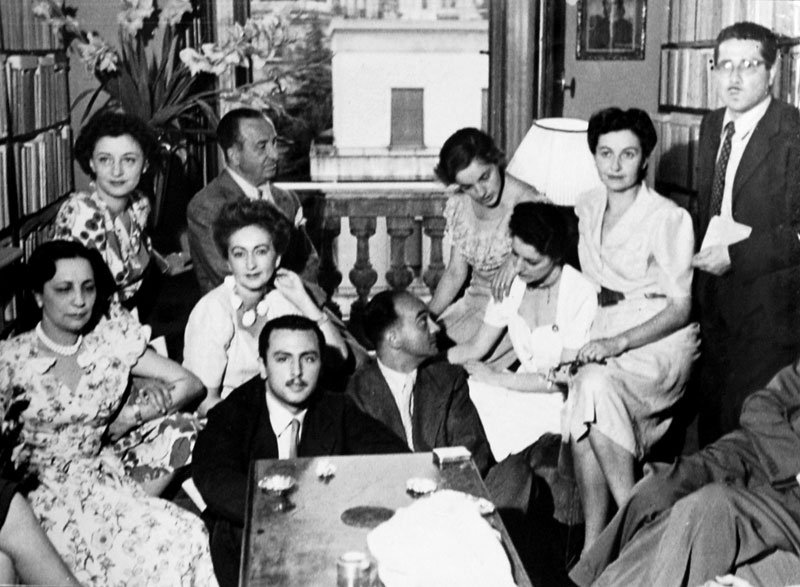
1947. The “Amici della domenica” take part in the 1st Premio Strega.
On the right, Ennio Flaiano © Premio Strega, Fondazione Bellonci
Time to Kill is a novel written in one sitting, set during the years of the Italian Royal Army’s occupation of Ethiopia. Flaiano himself had been called to arms in the fall of 1935 and shipped off to Ethiopia with the rank of second lieutenant to participate in the imperialist ambitions of the Kingdom of Italy and, in particular, of Benito Mussolini, then Prime Minister and Minister of Foreign Affairs.
The plot of the novel is thus inspired by Flaiano’s own reflections and encounters during his months stationed in Ethiopia, though it eventually diverges completely from them in the more fictionalized part of the story.
In the midst of the Italian occupation of Ethiopia, a lieutenant on temporary leave narrowly escapes death when the truck carrying him to the village nearest his camp overturns. Stunned by the accident, he decides to continue on foot along the trails and shortcuts of the Ethiopian forest, and suddenly, now lost in the bush, he encounters a “native” woman immersed in a pond, washing her naked body.
Blinded by lust and his sense of superiority as an occupier—and thus a usurper and oppressor—the lieutenant rapes the woman. In the pitch-black darkness of the African night, the lieutenant fires his revolver into the bush to scare away a wild animal, but a bullet is deflected by a rock and mortally wounds the girl still lying beside him. To avoid a court-martial, the lieutenant hides the body. This is where his ordeal begins—a journey through the African steppes haunted by tormented souls; a path marked by doubt, uncertainty, pain, paranoia, and remorse.
The novel departs from the dominant neorealist trend of the time and weaves a poignant, surreal tale—a drama of the unconscious, a torrent of thoughts, a stream of consciousness bordering on surrealism. This stylistic trait is evident in all of Flaiano’s screenplays.
Just as Louis-Ferdinand Céline, in Journey to the End of the Night, recounts the First World War with cynicism and despair, in Time to Kill, Flaiano shows us, through the bewildered eyes of a naive colonizer fighting his own inner war, the true war in Ethiopia; that dark and soon-to-be-forgotten chapter of history in which we Italians were cruel occupiers and tried by every means to subjugate an entire people.
In 1989, Giuliano Montaldo (Sacco and Vanzetti) directed a film adaptation of Flaiano’s novel of the same name, starring Ricky Tognazzi, Giancarlo Giannini, and Nicolas Cage as the lieutenant. The film, an Italian-French co-production, was distributed in Italy by Titanus, and the score was composed by Maestro Morricone.
The film draws inspiration from famous American war films of the era, such as Full Metal Jacket or Platoon, and like them, Montaldo’s film does not focus on the war itself, but rather on the protagonist’s inner conflict. Lieutenant Enrico Silvestri (here the protagonist is given a first and last name, unlike in Flaiano’s novel, which leaves the lieutenant unnamed precisely to make him a universal symbol) embarks on a journey through the mountain forests of Ethiopia; a journey that becomes a metaphor for guilt and atonement through an illness the lieutenant contracts during his wanderings. The extreme close-ups of the protagonist emphasize his loss of reason in the face of his own actions and the senselessness of war.
Despite its flashy titles and Nicolas Cage’s spot-on, over-the-top performance, the film wasn’t particularly successful in its own right and certainly didn’t have the same impact that the 1947 novel had—and still has today.

Time to Kill, directed by Giuliano Montaldo and starring Nicolas Cage
Ennio Flaiano, whom screenwriter Suso Cecchi D’Amico described as a quiet man, an attentive listener, and extremely ambitious, for some reason never attempted to write another novel. Although Tempo di uccidere is a one-of-a-kind work, there is no doubt that it remains one of the great novels of the last century, destined to gain ever greater significance as awareness and rediscovery grow—perhaps in light of recent tragic events—of a tragic past marked by violence and oppression, in which the Italian people were not only victims but also perpetrators.
Ennio Flaiano truly deserves a leading role in Italian literature alongside other great 20th-century writers from Abruzzo, such as Ignazio Silone and Gabriele D’Annunzio. Flaiano, today more than ever, is an author who needs to break free from the overly simplistic label of “Fellini’s screenwriter” and emerge as a well-rounded writer—one who has influenced the imagination and perhaps even the very identity of an entire generation of Italians, a generation of a carefree, dreamy era that was, at the same time, sadly aware of a jammed mechanism. A man with a dark weight in his heart who nevertheless persists in moving forward, whistling.
Among the positive aspects of my Abruzzese heritage, I would also include tolerance, Christian compassion (in the countryside, a man is still considered “a Christian”), a good-natured disposition, simplicity, and sincerity in friendships; that is, always forming my opinion based on first impressions and never changing my judgment of people, accepting them as they are, recognizing their flaws as my own—indeed, seeing my own flaws reflected in theirs.
Pasquale Scarpitti, Disillusionment, Sarus, Teramo, 1972

Samuele Coccione
An exile by necessity, but mostly out of masochism.
I love movies, books, and boredom.
I’ve been writing about Abruzzo cinema ever since it was “cool”
to be stuck at home.
I live in Milan, but I dream of working remotely with my feet soaking in the Tirino River.